How I Built an AI System to Generate Long-Form YouTube Videos — Hourly and Effortlessly
Have you ever stumbled upon a YouTube channel with just a handful of videos but an astonishing number of subscribers? Recently, I discovered a channel with merely 33 videos yet boasted over 1.35 million subscribers. The secret? Simple clips of motivational voiceovers, paired with compelling visuals. People find value in these motivational nuggets, and it got me thinking—what if I could automate this entire process?
So, I set out to build an AI system using no-code automation tools to generate long-form YouTube videos. Here’s my journey, insights, and how you can replicate this workflow too.
The Realization
One evening, while exploring YouTube, I was struck by the vast potential of automated content creation. The idea that I could set up a system to continually generate video content around a niche, like stoicism, was enthralling. I envisioned an approach where I could establish the workflow once and watch it churn out videos hourly—rich with motivational content, haunting visuals, and the soothing melody of background music.
This wasn’t just an exercise in technical prowess; this was about harnessing AI to create something of value—a tool to inspire others and possibly generate a side income while I sleep.
Creating the AI Workflow
Setting up the system was more straightforward than I imagined. The foundation of my automation consists of two primary agents:
- Ideas Agent: This is where I provide direction and inspiration.
- Creator Agent: This takes the ideas and develops them into fully-fledged videos.
Step 1: Generating Ideas
I started with creating an Ideas Agent using ChatGPT. I crafted a prompt to help me brainstorm video ideas—something as simple as asking it to generate motivational content ideas on stoicism. The output was a treasure trove of unique themes to explore:
- “The stoic lion: unshaken amidst life’s storms.”
- “Lessons from a bear: patience in adversity.”
With these ideas, I moved to my next step—the actual video creation process.
Step 2: Building the Creator Agent
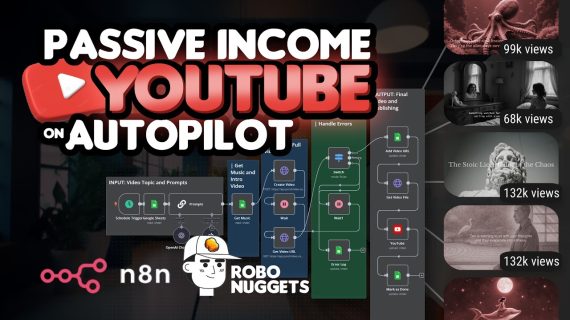
For this, I used N8N, a powerful no-code automation tool. It allows you to create workflows that can connect various applications, handling everything from generating visuals to managing audio.
- Pull Video Ideas: I set up a node to pull the generated video ideas from a Google Sheet.
- Generate Visuals: An AI model linked to N8N generates visuals based on the corresponding prompts.
- Create Voiceovers: I integrated another model for voiceovers. This step transforms written prompts into engaging auditory experiences.
The beauty of N8N lies in its intuitive design—a simple drag-and-drop interface. Even if you’re a beginner, creating a functional system felt within reach.
Adapting to Different Niches
The real power of this workflow is its adaptability. If motivational content isn’t your cup of tea, consider other niches:
- Sleep Stories: “Under the stars, lullabies whispering through dreams.”
- Horror Content: “Behind the mirror, how shadows dance in silence.”
- Children’s Stories: “Dandelion meadows, with bees buzzing sweetly.”
Once I had the framework set, I knew anyone could customize their output according to their preferences.
What I’d Do If I Started Today
If I were to embark on this journey again, I’d prioritize the following:
- Choose a Subject I Love: Selecting a niche I’m passionate about would ensure the content creation process is enjoyable.
- Batch Idea Generation: Spend a weekend generating ideas for several weeks. This reduces the friction of coming up with content regularly.
- Experiment with Voices and Visuals: Utilize various models until I find the right fit for my themes. Each nuance can make a difference.
- Join a Community: Engaging with like-minded individuals can provide motivation and inspiration. Surrounding myself with people who are also leveraging AI will broaden my perspective.
The Final Touches
With everything set up, I tested my automation flow. The output? A polished, captivating video ready for upload to YouTube—all without lifting a finger once the process was in motion.
The system even included a feedback loop, marking which ideas performed well, ensuring continual fine-tuning.
Conclusion
Building this AI system has been an eye-opening experience, revealing the potential that lies in automation and creativity. I’ve turned a fascination into a functional workflow that not only generates content but also inspires.
If you’re curious about building systems that save you from burnout and free up your time, I created something that might help. It’s a small online course called Automation by RoboNuggets, where I share the exact tools and workflows I wish I knew earlier. You can check it out here, only if it feels right for you.
Harness the power of AI to not just dream but also do. Your ideas could inspire thousands, just like the channels that sparked my journey.